Web Creation Nepal Private Limited
Get a Quote

Contact Support

977-01-5343968 / 9851029233[email protected]
Sunday – Friday: 09:00 AM – 06:00 PM

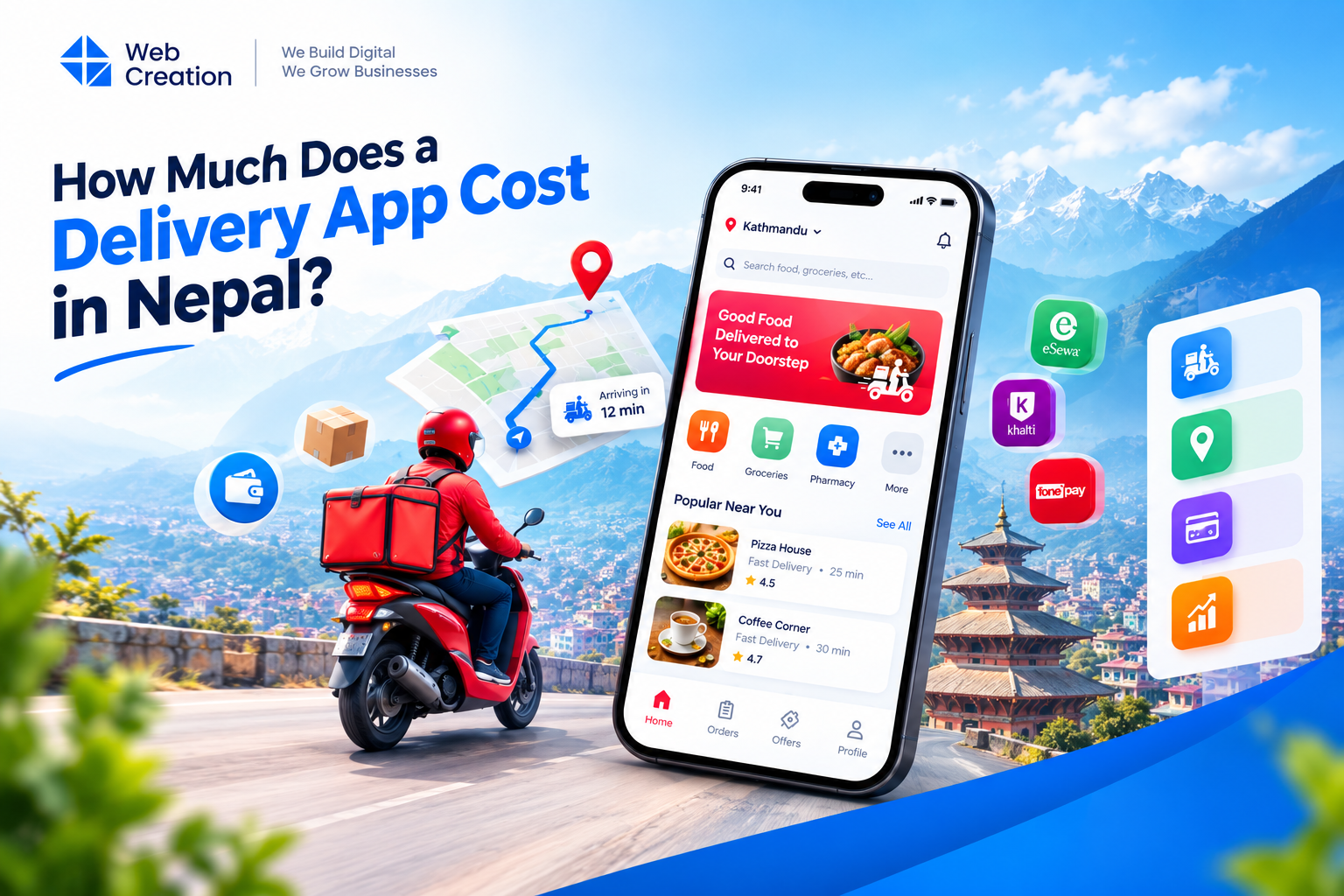
How Much Does a Delivery App Cost in Nepal?

September 10, 2026
12 min read
Share:
How Much Does a Delivery App Cost in Nepal?
Listen to this article

Wondering how much a delivery app costs in Nepal? Here's a simple breakdown of pricing, features, payment options, and what to expect before you start.

How Much Does a Delivery App Cost in Nepal?

If you run a restaurant, grocery store, pharmacy, or courier business in Nepal, chances are you've thought about building your own delivery app. Maybe you're tired of paying big commissions to third-party platforms, or you just want more control over how you reach your customers.

The first question everyone asks is: how much will it actually cost?

This guide walks you through pricing, must-have features, payment options, and everything else you should know before you start — explained in plain, simple language. If you're comparing app types more broadly, our guide to app development in Nepal is a good place to start too.
Why So Many Businesses in Nepal Want Their Own Delivery App

A few years back, most small businesses just relied on delivery apps like Foodmandu or Pathao to get orders. That's changing. Traffic in cities like Kathmandu keeps getting worse, more people are ordering everything from their phones, and business owners are realizing how much they're losing to platform commissions every month.

With your own app, you keep more of what you earn, you own the relationship with your customers, and you control the whole experience — from browsing to checkout to delivery. That's a big deal if you're trying to build a loyal customer base instead of just being one option among many on someone else's app.

So, How Much Does It Actually Cost?

Here's a simple starting point. Prices vary based on what you need, but this table gives you a realistic idea:
Type of AppEstimated Cost (NPR)What You Get
Basic version4,00,000 – 8,00,000One delivery type, simple ordering, one payment option
Standard app8,00,000 – 18,00,000Customer app + rider app, live tracking, multiple payment options
Full platform20,00,000 – 40,00,000+Multiple vendors, admin dashboard, reports, built to scale

Think of these as starting ranges, not fixed prices. A small app for one restaurant will cost less. A platform meant to handle hundreds of vendors and thousands of orders will cost more.

Where the Money Goes

It helps to know what you're actually paying for:

  • Basic ordering system (browsing, cart, checkout): NPR 1,00,000 – 2,50,000
  • Rider app with live location tracking: NPR 1,50,000 – 3,50,000
  • Admin dashboard for managing everything: NPR 1,00,000 – 3,00,000
  • Each payment gateway you add: NPR 30,000 – 80,000
  • Notifications and OTP messages: NPR 20,000 – 50,000
  • Support for multiple vendors: NPR 3,00,000 – 8,00,000

Some agencies in Nepal charge by the hour (roughly NPR 1,500–4,000), while others give you one fixed price for the whole project. If you're building your first app, a fixed price is usually safer — it protects you from surprise costs later. If you're running a salon, clinic, or service business instead of a delivery business, a lot of this pricing logic also applies to booking and appointment apps.

What Makes the Price Go Up or Down

A few things really change the final number:

  • How many apps you need — most delivery businesses need three: one for customers, one for riders, and one for admin. Each one takes time to build.
  • Live tracking — showing customers exactly where their order is in real time takes extra work behind the scenes.
  • Payment options — every payment method you add needs to be set up and tested separately.
  • Design — a custom look built just for your brand costs more than using a simple, ready-made design.
  • Android and iOS — building separately for each platform costs more than building once for both.
  • Maps and messaging tools — things like Google Maps or SMS services often have their own usage costs on top of development.
  • How big you're planning to grow — an app built for a handful of daily orders is simpler than one built to handle thousands.

Features You Really Need

For customers

  • Browse products, restaurants, or services
  • Add to cart and check out easily
  • Track their order in real time
  • Get notified when their order status changes
  • See order history and reorder with one tap
  • Leave ratings and reviews

For delivery riders

  • Accept orders and get directions
  • Share their live location with the customer
  • See their earnings and payment history
  • Switch between online and offline

For you (the admin)

  • Manage orders, vendors, and riders in one place
  • See sales reports and trends
  • Set up discounts and promotions
  • Handle customer complaints and support requests

If you skip the rider app, you'll likely end up coordinating deliveries manually over WhatsApp or phone calls — which works fine for a few orders a day, but falls apart quickly once things get busier.

Payment Options People Expect

In Nepal, customers expect to pay however is easiest for them. Most apps offer:

  • eSewa and Khalti — the two most commonly used digital wallets
  • ConnectIPS — popular for direct bank transfers
  • Cash on Delivery — still very common, especially outside Kathmandu Valley

Offering at least two digital wallets plus cash on delivery covers most of your customers without making checkout feel complicated. If you want the technical details on how these connect to your app, check out our payment gateway integration guide.

What's Under the Hood (Tech Stack)

You don't need to be technical to understand this, but it's good to know what your developer is building with:

  • App itself: Flutter or React Native — these let developers build one app that works on both Android and iPhone, saving time and money
  • Backend (the part customers don't see): Node.js or Laravel, paired with a database to store orders, users, and vendor info
  • Live tracking: Google Maps or Mapbox, updated in real time
  • Notifications: Firebase, so customers get instant alerts
  • Hosting: Cloud servers that can handle your traffic and grow with you

This combination is widely used by app developers in Nepal because it keeps costs reasonable without sacrificing quality.

Should You Build for Both Android and iOS?

OptionGood ForDownside
Separate apps for each platformBig, well-funded businessesCosts the most
One app that works on both (cross-platform)Most small and medium businessesSmall trade-offs, but rarely noticeable
Simple web-based appVery tight budgetsFeels less smooth to use

For most businesses starting out, building one app that works on both Android and iPhone is the smart choice. You reach everyone without doubling your budget.

How Long Will It Take?

  • Basic version: 6–10 weeks
  • Standard app (customer, rider, and admin): 10–16 weeks
  • Full platform with multiple vendors: 4–6 months

Timelines can stretch if payment gateway approvals take a while, or if the app store review process takes longer than expected. It's smart to leave some extra time in your plan rather than promising an exact launch date too early.

Should You Build From Scratch or Use a Ready-Made App?

Ready-made (white-label) apps are quicker and cheaper — you're basically customizing something that already exists with your branding. This is a good option if you just want to test the idea before spending a lot of money.

Custom-built apps cost more and take longer, but they're yours completely. You can add any feature you want, and there's no ceiling on how much you can grow. If you're planning to expand to new cities or add new services down the line, custom is usually the safer bet — ready-made apps tend to hit limits once your business grows past what the template was designed for.

Don't Forget Costs After Launch

Building the app is just the beginning. After launch, plan for:

  • Maintenance and updates: usually around 15–20% of your original development cost, every year
  • Hosting: typically NPR 5,000–50,000+ a month, depending on how many orders you're processing
  • Maps, SMS, and payment fees: often charged per use
  • App store fees: Google Play charges a one-time $25, Apple charges $99 every year

A lot of business owners forget this part and then wonder why their app starts having problems a year later. Skipping maintenance is one of the easiest ways to end up with a broken app and unhappy customers — the same way website maintenance gets overlooked after a site launch.

How to Pick the Right Development Company

  • Ask to see apps they've built before — specifically delivery or logistics apps, not just any website or app
  • Make sure they can connect eSewa, Khalti, and ConnectIPS directly, without messy workarounds
  • Ask exactly what support you'll get after launch, and for how long
  • Get a detailed quote that breaks down each feature, not just one big number
  • Ask what happens to cost and performance if your orders triple in a few months

Mistakes to Avoid

  • Trying to build every feature at once instead of starting simple and adding more once you know what customers actually want
  • Skipping the rider app and managing deliveries by hand, which only works for a short while
  • Forgetting to budget for maintenance, leaving your app to slowly fall apart after launch
  • Picking the cheapest option without checking if the team actually has experience with real-time, location-based apps

Frequently Asked Questions (FAQ)

How much does it cost to build a delivery app in Nepal?
A simple app usually starts around NPR 4–8 lakh. A full-featured app with live tracking, multiple payment options, and an admin dashboard can cost NPR 15–40 lakh or more.
How long does it take to build one?
A basic version usually takes 6–10 weeks. A complete app with customer, rider, and admin sections can take 3–6 months.
Which payment options should I include?
eSewa, Khalti, and ConnectIPS cover most digital payments in Nepal, and it's worth keeping cash on delivery too, especially if you serve areas outside the city.
Should I build separately for Android and iPhone, or one app for both?
Most businesses in Nepal choose one app that works on both — it's faster to build, cheaper, and works just as well for everyday use.
Do I really need a separate app for delivery riders?
Yes. Once you're getting more than a handful of orders a day, a rider app for accepting orders, navigation, and tracking earnings becomes essential.
Should I build a custom app or use a ready-made one?
Ready-made apps are cheaper and quicker to launch, but limited. Custom apps cost more upfront but grow with your business without hitting a ceiling.
What costs should I expect after the app is live?
Plan for around 15–20% of your development cost every year for maintenance, plus monthly hosting and any per-use fees for maps, SMS, or payments.

Discussion & Feedback

Share your thoughts, ask questions, or provide feedback on this blog. All comments are moderated before being published.

Leave a Reply

Your email address will not be published. Required fields are marked *

Recent Comments

Loading discussion...
Call: 9851029233Email: [email protected]