Web Creation Nepal Private Limited
Get a Quote

Contact Support

977-01-5343968 / 9851029233[email protected]
Sunday – Friday: 09:00 AM – 06:00 PM

How to Build a Multivendor eCommerce Website in Nepal

October 11, 2026
8 min read
Share:
Multivendor eCommerce Website in Nepal
Listen to this article

Want to build an online marketplace in Nepal? Learn what a multivendor website is, the features you need, the best platforms, payment options, and the steps to launch.

Multivendor eCommerce Website in Nepal

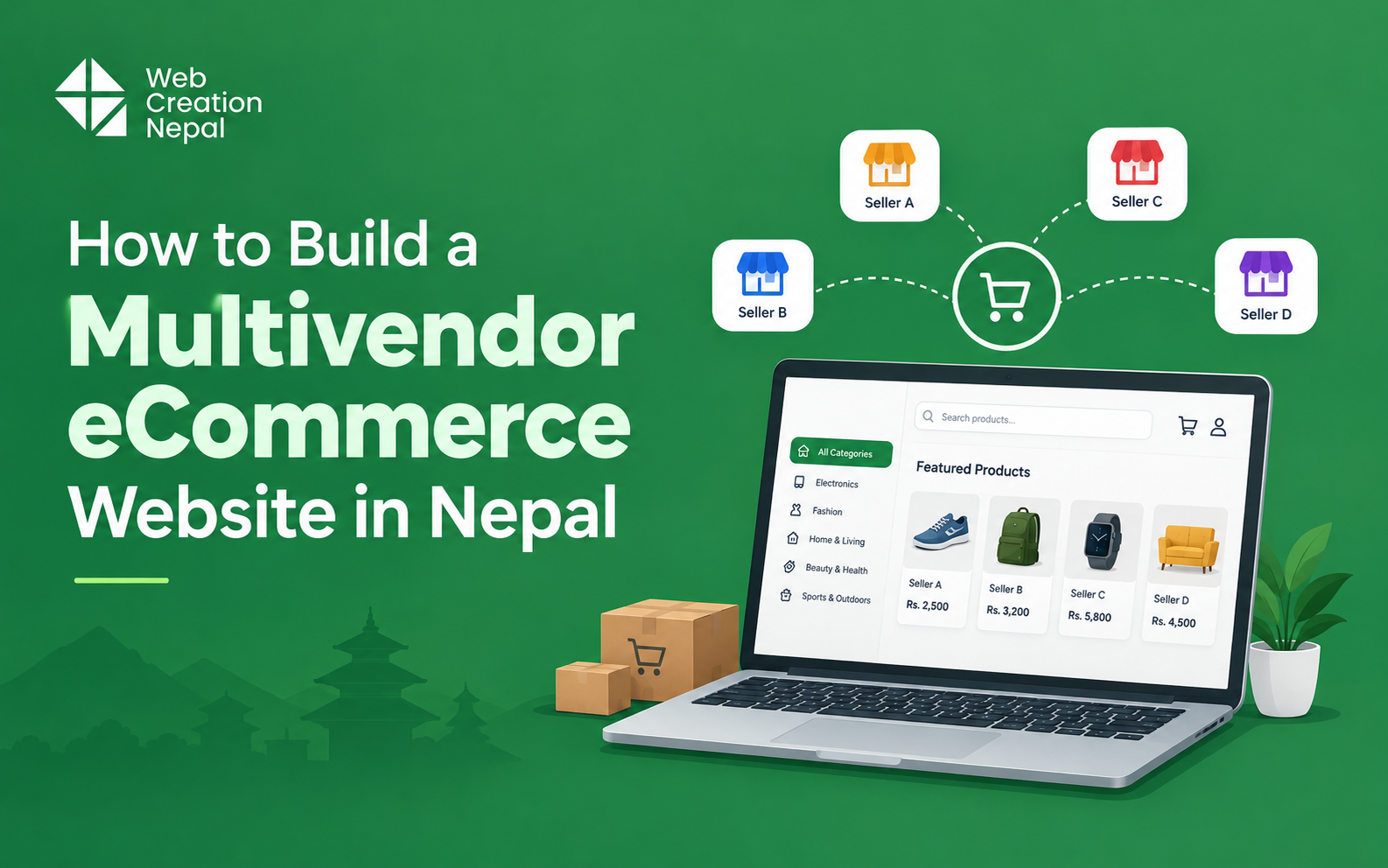
A multivendor eCommerce website is an online marketplace where many sellers sell their products on one website. Daraz is the best-known example in Nepal. You own the platform, sellers list their products, and you earn a commission on each sale.

This guide explains how to build one in Nepal in simple steps. It covers features, platforms, local payments, delivery, and common mistakes.

Quick answer: To build a multivendor website in Nepal, pick a niche, choose a platform (WooCommerce is the easiest to start with), add seller and admin dashboards, connect eSewa, Khalti, and Cash on Delivery, test the full order and payout flow, then launch with a small group of trusted sellers.

What Is a Multivendor eCommerce Website?

A multivendor eCommerce website is an online store with more than one seller. Each seller gets a login, adds their own products, and manages their own orders. The marketplace owner controls the platform and the rules.

Think of it like a shopping mall. The mall owner provides the building, and each shop owner runs their own shop inside. In a multivendor website, you provide the website and the sellers run their own “shops” on it.

Well-known marketplaces include Daraz, Amazon, Etsy, and eBay.

How Is It Different From a Normal Online Store?


Normal online storeMultivendor marketplace
SellersOne businessMany businesses
InventoryYou buy and hold stockSellers hold their own stock
IncomeProfit on your own productsCommission, fees, and ads
ComplexitySimplerMore complex
Best forA single brandA niche marketplace

If you only want to sell your own products, a regular store is simpler and cheaper. Our guide on how to start an online store in Nepal walks you through that path step by step.

Why Start a Marketplace in Nepal?

More Nepali shoppers now buy online and pay with digital wallets. At the same time, there are still many gaps. Large platforms cover general shopping, but niche markets are often poorly served.

Some ideas that can work:

  • Handmade crafts and Himalayan products
  • Organic and local food
  • Local fashion and clothing
  • Books and stationery
  • Services such as home repair, tutors, or event vendors
  • Second-hand goods

A focused marketplace is easier to build and easier to market. People trust a platform that does one thing well.

Features Your Marketplace Needs

A marketplace serves three groups of users: you (the admin), sellers, and customers. Each group needs its own tools.

Admin Features

  • Approve or reject new sellers
  • Set commission rates (for all sellers, by category, or per seller)
  • Check products, orders, and reviews
  • Pay sellers their earnings
  • See sales reports
  • Handle refunds and disputes

Seller Features

  • A simple dashboard with sales and earnings
  • Easy product upload with options like size and color
  • Stock and order management
  • Withdrawal requests
  • A personal store page with a logo and banner
  • Basic coupon tools

Customer Features

  • Search with filters for price, category, seller, and rating
  • One cart and one checkout, even for items from different sellers
  • Seller profiles and product reviews
  • Order tracking
  • Clear return policy
  • A fast, mobile-friendly design

Tip: If your budget is limited, spend it on the seller dashboard and the checkout. Sellers leave when uploading is hard, and customers leave when paying is confusing.

Best Platforms to Build On

PlatformBest forThings to know
WooCommerceStartups and small to mid-size marketplacesLower cost, quick launch, easy to manage
MagentoLarge catalogs and complex rulesPowerful, but needs a bigger budget and stronger hosting
OpenCartSimple marketplaces with moderate trafficSmaller extension library
Custom build (Laravel, Next.js)Unique ideas and large plansFull control, higher cost, longer build time

Our advice: Start with WooCommerce unless your idea truly needs something special. You can always move to a custom build later when you have real sellers and real orders.

Not sure which technology fits your business? Read our comparison of the best website technology for businesses in Nepal (WordPress, Laravel, or Next.js). For a wider look at how the process, cost, and platforms fit together, see our guide to ecommerce development in Nepal.

Payments and Delivery in Nepal

A marketplace that works in Nepal must follow how Nepali people actually pay and receive orders.

Payments

  • eSewa and Khalti: the most popular digital wallets
  • Fonepay and ConnectIPS: useful for bank and QR payments
  • Cash on Delivery (COD): still important, because many customers want to pay when the parcel arrives
  • International cards: helpful if you want to serve buyers abroad

Marketplaces also need a way to split money between you and the sellers. Most collect the full payment first and pay sellers afterward, after taking their commission.

For the technical side, see our payment gateway integration guide for Nepal.

Delivery

Decide early how orders will reach customers. There are three common options:

  • Sellers ship their own orders
  • You handle delivery for everyone
  • A mix of both, depending on the seller or location

Delivery inside Kathmandu Valley is much easier than delivery to remote areas, so be clear about where you can deliver and how long it takes.

Language and Notifications

Offer the site in English and Nepali if your customers need it. Send order updates by SMS and email. This reduces support calls a lot.

If your sellers also have physical shops, you may need to connect your marketplace to their billing system. We cover that in our guide to POS and ecommerce integration for multi-store businesses in Nepal.

Step-by-Step: How to Build a Multivendor Website

Step 1: Pick Your Niche and Plan

Decide what you will sell, who will buy it, and how you will earn. Write down your seller rules: commission rate, payout timing, and what products are not allowed.

Step 2: Choose Your Platform

Use the table above. For most startups, WooCommerce with a multivendor plugin is the best starting point.

Step 3: Design for Sellers and Shoppers

Many projects only design the shop front. Do not forget the seller dashboard. A clean design on both sides helps you win and keep users. If you need help choosing a design partner, our guide on the best web design company in Nepal lists what to check before you hire.

Step 4: Build the Core Features

This includes seller sign-up, product management, the shared cart and checkout, and the commission system that splits each payment.

Step 5: Add Payments, Delivery, and Notifications

Connect eSewa, Khalti, COD, your delivery partners, and SMS or email alerts.

Step 6: Test the Full Journey

Do not only test pages. Test the complete flow:

  • A seller signs up
  • The seller adds a product
  • A customer buys it
  • The commission is calculated
  • The seller requests a payout
  • A refund is processed

Most marketplace bugs hide in the money flow.

Step 7: Launch Small

Start with a small group of trusted sellers and real products. Fix problems before you spend on advertising.

Step 8: Grow and Maintain

Keep the site updated, fast, and secure. Then work on getting found. Our SEO services in Nepal guide explains how SEO works and what to expect.

How Multivendor Websites Make Money

  • Commission: a percentage of each sale (the most common model)
  • Seller subscriptions: a monthly or yearly fee to sell on your platform
  • Listing fees: a small fee per product listed
  • Featured placement: sellers pay to appear at the top
  • Ads: banner spaces on your site

Many marketplaces start with commission only and add other income later.

How Much Does It Cost?

The cost depends on your platform, features, design, and integrations.

  • Basic marketplace (WooCommerce + plugin): the most affordable option
  • Mid-range marketplace (custom design and local integrations): a moderate budget
  • Fully custom marketplace: the highest cost, best for unique ideas

Do not forget costs beyond development: hosting, domain, SSL, payment gateway setup, maintenance, and marketing. For a general idea of website pricing, read our web development in Nepal guide. If you plan to add a mobile app later, see how much mobile app development costs in Nepal.

The best way to get an exact price is to share your requirements and ask for a detailed quote.

Common Mistakes to Avoid

  • Chasing customers before sellers. An empty marketplace does not bring buyers back. Sign up good sellers first.
  • Making the seller dashboard hard to use. Sellers will move to another platform.
  • Unclear money rules. Explain commission, payout dates, and refunds in plain words.
  • Weak quality control. A few fake or low-quality listings can hurt trust. Check new sellers and products.
  • Ignoring mobile users. Most shoppers use phones, often on average internet. Test on real phones.
  • Skipping security. You handle payments and personal data. Use SSL, strong passwords, backups, and regular updates.
  • Building too much at the start. Launch with the basics. Add features once you know what users need.

Final Thoughts

Building a multivendor eCommerce website in Nepal is a real opportunity, but it takes more than good technology. The marketplaces that last keep rules simple, treat sellers and customers well, and grow step by step.

Start with a clear niche, choose a platform that fits your budget, connect the payment and delivery methods Nepali people use, and launch small. Then improve as you learn.

Ready to build your marketplace? The team at Web Creation Nepal can help you choose the right platform, features, and budget. Contact us to talk about your idea, or see our services.

Frequently Asked Questions (FAQ)

What is a multivendor eCommerce website?
It is an online marketplace where many sellers list and sell products on one website. The owner manages the platform and earns from commissions or fees.
How long does it take to build a multivendor website in Nepal?
A basic WooCommerce marketplace can take a few weeks. A more custom build can take a few months. Delays usually come from unclear requirements, not from coding.
Which platform is best for a multivendor website in Nepal?
WooCommerce with a plugin like Dokan or WCFM is the best choice for most startups. Magento or a custom build suits larger or more complex marketplaces.
Can I use eSewa and Khalti on a multivendor website?
Yes. Both can be integrated. Splitting payments between sellers needs careful setup, so most marketplaces collect the full payment first and pay sellers later.
Do I need a mobile app for my marketplace?
Not at the start. A fast, mobile-friendly website is enough to test your idea. You can add an app once you have steady customers. See our app development in Nepal guide when you are ready.
Is Cash on Delivery necessary?
For most Nepali marketplaces, yes. Many customers still prefer to pay when they receive the product. Just plan for returns and refused deliveries.
How do multivendor websites make money?
Mainly through commission on sales. Other options are seller subscriptions, listing fees, featured placement, and ads.
Who can build a multivendor website in Nepal?
Look for a team with real eCommerce and payment integration experience. See our list of top web development companies in Nepal for what to compare before you choose.

Discussion & Feedback

Share your thoughts, ask questions, or provide feedback on this blog. All comments are moderated before being published.

Leave a Reply

Your email address will not be published. Required fields are marked *

Recent Comments

Loading discussion...
Call: 9851029233Email: [email protected]