Web Creation Nepal Private Limited
Get a Quote

Contact Support

977-01-5343968 / 9851029233[email protected]
Sunday – Friday: 09:00 AM – 06:00 PM

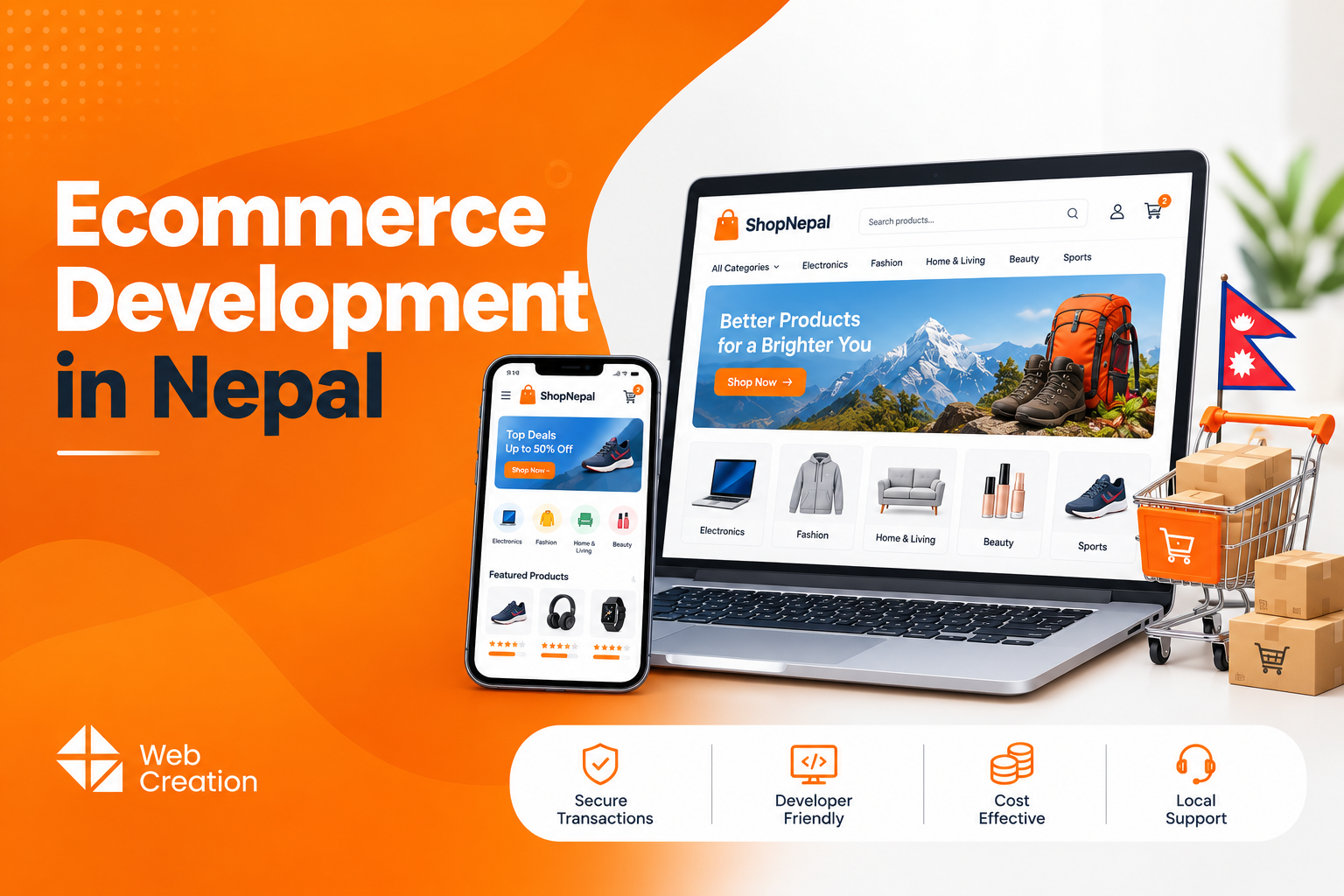
Ecommerce Development in Nepal: Process, Cost, Platforms & What to Expect

September 15, 2026
12 min read
Share:
ecommerce development in Nepal
Listen to this article

A simple guide to ecommerce development in Nepal — the process, cost, platforms, payment gateways, and how to pick the right developer.

Ecommerce Development in Nepal

A few years back, buying something online in Nepal usually meant scrolling through a Facebook page, sending a DM, and just hoping the delivery guy showed up. That's not how it works anymore. eSewa and Khalti feel as normal as cash now. Delivery riders actually show up on time, most of the time. And people expect to browse, compare, and pay online without ever calling anyone.

If your business is still running on a Facebook page or an old website that doesn't really sell anything, you're missing out on sales. And if you've started looking into ecommerce development in Nepal, you've probably noticed most of the information out there isn't very helpful. It's either too vague, written for a completely different country, or full of promises with no real explanation.

This guide is here to fix that. In plain language, we'll cover what ecommerce development actually means, what it costs in Nepal, which platform might suit you, mistakes to avoid, and what the whole process looks like from your first conversation with a developer to the day your store goes live.

Why Ecommerce Matters More in Nepal Now Than Before

A few things have changed at the same time, and together they've made ecommerce a real option for Nepali businesses — not just something big companies do.

Digital payments are everywhere now. eSewa, Khalti, and ConnectIPS aren't just for tech-savvy people anymore. Even smaller towns outside the valley use them. That means "how will people even pay me" isn't a real problem anymore.

Phones got faster, internet got cheaper. Most of your customers will find you on their phone, not a laptop. This changes everything about how a website should be built. A site that looked fine a few years ago probably feels slow and clunky today.

People trust online shopping more. After a few years of good (and some bad) experiences, people aren't as scared to buy online as they used to be. But that trust only helps you if your site looks and feels professional. A slow site, broken images, or a checkout page that redirects three times will kill that trust instantly.

Festival shopping has moved online. Dashain and Tihar shopping used to mean crowded markets. Now a good chunk of that spending happens through online stores, especially for clothes, electronics, and gifts.

None of this guarantees success. It just means the ground is finally solid enough that building a real online store is worth doing — as long as it's done properly.

What Does Ecommerce Development Actually Mean?

"Build me an online store" sounds simple, but it's really a bunch of smaller pieces working together. A proper ecommerce site for Nepal usually needs:

  • A product catalog — your products, organized with sizes, colors, prices, and stock levels, so people can actually find what they're looking for
  • A design that works well on phones — because most of your visitors will be on a mid-range Android phone, not a laptop
  • Payment options — eSewa, Khalti, and ConnectIPS at the very least, plus card payment if you sell outside Nepal
  • Delivery integration — connecting with couriers like Pathao, NCM, or Sundar Yatra so you're not calling a rider every time to ask where a package is
  • A dashboard to manage orders — so you can see new orders, process refunds, and check a customer's history without digging through messages
  • Basic SEO — clean pages, good product descriptions, and fast loading, so Google can actually find and rank your site
  • Security — an SSL certificate and a safe checkout, which matters both for your customers' trust and for your Google ranking

If any of these are missing, you don't really have an online store — you have a product list with a "message us to order" button. That might be fine when you're just starting out, but it won't take you very far.

How Ecommerce Development Works, Step by Step

Here's roughly what happens from your first conversation with a developer to the day you launch.

1. Talking Things Through First

Before any design work starts, a good developer should be asking you questions, not the other way around. How many products do you sell? Will that number grow fast? Who are your customers? Are you shipping across the country, or mostly within the valley?

Your answers decide whether you need a simple store or something bigger, like a system that tracks stock across multiple warehouses. Skipping this step is one of the biggest reasons projects go over budget — new features get added halfway through because nobody asked the right questions at the start.

2. Choosing a Platform

This is where a lot of business owners get stuck, scrolling through comparison articles late at night. Shopify, WooCommerce, and a fully custom-built site all work differently — in cost, flexibility, and how well they handle Nepali payment gateways.

We've written more about this in our guide on how to choose the right ecommerce platform for your business in Nepal. In short: platforms you can customize, like WooCommerce or a custom build, usually work better here, mostly because eSewa and Khalti support is easier to add without fighting the platform.

3. Designing the Store

This is where a lot of stores quietly lose money without anyone noticing. Since most visitors are on phones, the design needs to load fast and make checkout as simple as possible.

Every extra step at checkout is a chance for someone to give up and leave. We've seen stores get way more sales just by cutting checkout from five steps down to two — no big redesign needed, just fewer chances for people to quit halfway.

4. Building the Site and Connecting Payments

This is the actual construction work — setting up the product catalog, shopping cart, checkout, and connecting the payment gateways so money moves smoothly from your customer's wallet to your account.

For a deeper look at how eSewa, Khalti, ConnectIPS, and international payments get connected (and what usually goes wrong), check our payment gateway integration guide for Nepal.

5. Testing Everything Before Launch

Before going live, the site gets tested on different phones and browsers, and real (small) payments are tested through every payment method. This is also when load speed gets checked, because a site that takes eight seconds to load will lose people before they even see your products.

Rushing this step is one of the most common reasons stores run into trouble right after launch — a payment method that quietly fails, a menu that doesn't work on some phones, that sort of thing. It's not the exciting part of the project, but it's the difference between a smooth launch and a pile of angry messages in week one.

6. Support After Launch

A store isn't something you build once and forget. It needs regular updates, security checks, and new features as you grow. If you also run a physical shop, you'll want your online and offline stock to stay in sync — our guide on POS and ecommerce integration for multi-store businesses explains how to avoid selling something online that's already gone from your shelf.

How Much Does Ecommerce Development Cost in Nepal?

Let's not dance around this — it's what everyone actually wants to know first. Costs depend on how complex your store is, but here's a realistic range:
Business TypeWhat's Usually IncludedStarting Cost (NPR)
Small catalog storeUp to ~50 products, one payment method, simple design60,000+
Growing retail storeBigger catalog, multiple payment methods, delivery integration120,000+
Custom ecommerce platformAutomated stock tracking, multiple warehouses, wholesale and retail together250,000+

These numbers change based on design, how many features you need, and whether you're using a template or building from scratch. For more detail across different business sizes, see our Website Development Cost in Nepal guide.

One honest tip: the cheapest quote usually isn't the cheapest option in the long run. A store built without proper testing, security, or SEO tends to need a rebuild within a year or two — and that ends up costing more overall than doing it right the first time.

Custom Build vs Ready-Made Platform

FeaturesReady-Made (Shopify / WooCommerce)Custom Build
How fast you launchFasterStandard speed
Starting costLowerHigher
Local payment supportSometimes needs extra pluginsBuilt exactly how you need it
Room to growLimited by the platformFully flexible
Cost over timeOngoing fees and subscriptionsOne-time build, lower ongoing cost
Good forTesting an idea quickly, small shopsBusinesses planning to grow, or with specific needs

Neither option is "better" on its own — it depends on where your business is right now. If you're just testing whether ecommerce works for you, a ready-made platform is fine. If you're already established and need things like tight courier integration or stock synced across stores, a custom build usually pays off.

Features Every Nepali Ecommerce Site Needs

Some of these sound obvious, until you visit a few real Nepali online stores and notice how many skip them.

  • A design that actually works on phones, not just one that technically loads on a phone
  • eSewa, Khalti, and ConnectIPS, since that's what most Nepali shoppers actually use
  • Delivery tracking, so customers (and you) aren't calling a rider to ask where the package is
  • A clear return and refund policy, which quietly reassures nervous first-time online shoppers
  • Fast loading pages, because slow sites lose customers and get ranked lower by Google
  • Basic SEO from day one, instead of trying to fix it six months later once you realize nobody's finding you

Mistakes We See Businesses Make

Treating the website like a brochure, not a sales tool. A lot of stores focus on looking nice, but nobody thinks through how a visitor actually goes from browsing to paying with the fewest possible obstacles.

Waiting too long to think about SEO. Many businesses only start caring about SEO after a few months of no traffic — by then, they're starting from zero instead of building it in from the beginning.

Picking a platform based on price alone. The cheapest quote often doesn't include local payment gateway setup, which then becomes an expensive add-on later.

No plan for support after launch. A site nobody maintains slowly breaks down — plugins get outdated, small security holes appear, and something eventually stops working right when you need it most, like during a big sale.

Ignoring mobile speed. Testing a site only on office wifi, then calling it done without checking how it actually performs on a normal 4G connection, is something we see all the time.

How to Pick an Ecommerce Developer in Nepal

A few honest questions to ask before you sign anything:

  • Have they actually built ecommerce sites with Nepali payment gateways before, or mostly simple informational websites?
  • Do they offer support after launch, or do they disappear once the site is live?
  • Can they show you real stores they've built, ideally in a similar industry to yours?
  • Is SEO part of the plan, or something you'll be left to figure out on your own later?
  • Do they explain pricing clearly, or does everything stay vague until you've already paid a deposit?

If a developer can't answer these clearly, that's worth paying attention to.

A Simple Example of How This Usually Plays Out

Here's a pattern we see a lot. A clothing or home goods shop starts out on Facebook, with a few thousand followers. Orders come in through comments and DMs, which works fine at first — until things pick up and messages start slipping through the cracks. No clear record of what's paid, no easy way to track stock.

That's usually the point where a real ecommerce site stops being a "nice to have" and becomes necessary. It lets the business grow past what one person can manually track in their head. Most of the time, it starts small — a basic catalog, eSewa and Khalti connected, a simple checkout. SEO and delivery integration often get added a bit later, once there's real traffic worth optimizing for. It's rarely one big launch. It's usually a series of small, sensible steps, each one solving whatever is slowing the business down at that moment.

Where Ecommerce in Nepal Is Headed

A few things worth keeping in mind if you're building a store now, since they'll affect how much room you have to grow later.

Social media and online stores are blending together. Instagram tags, Facebook shopping, and WhatsApp catalogs are often where a customer's journey starts, even if they finish buying on your website. If your site loads slowly when someone taps through from Instagram, you're losing sales without even knowing it.

More people are searching in Nepali. Product names and descriptions written only in English fashion or tech terms might be missing a chunk of local search traffic.

Faster delivery is becoming the norm, not a bonus. As courier services improve, customers expect delivery windows instead of a vague "3 to 5 business days." Stores that can offer this, even in a few areas, tend to stand out.

Trust matters more as competition grows. Verified payment badges, clear refund policies, and real customer reviews are becoming bigger factors as shoppers have more choices than they used to.

You don't need every one of these on day one. But it helps to build your store on something — the platform, the code, the SEO setup — that can support these later, instead of something you'll have to tear down and rebuild in two years.

Ready to Build Your Online Store?

Web Creation Nepal has 16+ years of experience building fast, secure, and locally-friendly ecommerce sites — from design and payment setup to ongoing SEO support. Whether you're launching your first online store or moving on from a Facebook page that's outgrown itself, we can help you build something that actually turns visitors into customers.

Get a Free Consultation: Call +977 9851029233 or contact us today.

Frequently Asked Questions (FAQ)

How much does ecommerce development cost in Nepal?
Basic ecommerce websites usually start around NPR 60,000, and go up depending on your catalog size, design, and how many payment methods or integrations you need. See our full cost guide for more detail.
How long does it take to build an ecommerce website in Nepal?
A basic store usually takes about 3 to 4 weeks. A custom build with more features can take 6 to 10 weeks, depending on complexity.
Which platform is best for ecommerce in Nepal?
It depends on what you need. WooCommerce and custom builds tend to work better if you need tight local payment integration. Shopify can work well if you just want to get set up quickly. Our platform comparison guide goes into more detail.
Can I build my own online store instead of hiring a developer?
Basic platforms let you build a simple store yourself. But local payment gateway setup, delivery integration, and SEO are usually where businesses end up needing a developer's help, especially to avoid mistakes that are expensive to fix later.
Can I connect eSewa and Khalti to any platform?
Most platforms support it in some way, but how smoothly depends on the platform. WooCommerce and custom-built sites usually offer easier, more reliable integration than some foreign SaaS platforms.
What's the difference between a regular website and an ecommerce website?
A regular website mainly shares information — who you are, what you offer, how to reach you. An ecommerce website lets people actually buy something from start to finish — browsing, cart, checkout, payment, and tracking — without needing to message you directly.
Do I need SEO, or is good design enough?
You need both. A beautiful store nobody can find on Google isn't making any sales. SEO brings people to your site. Design and a smooth checkout are what convince them to actually buy once they're there.

Discussion & Feedback

Share your thoughts, ask questions, or provide feedback on this blog. All comments are moderated before being published.

Leave a Reply

Your email address will not be published. Required fields are marked *

Recent Comments

Loading discussion...
Call: 9851029233Email: [email protected]