Web Creation Nepal Private Limited
Get a Quote

Contact Support

977-01-5343968 / 9851029233[email protected]
Sunday – Friday: 09:00 AM – 06:00 PM

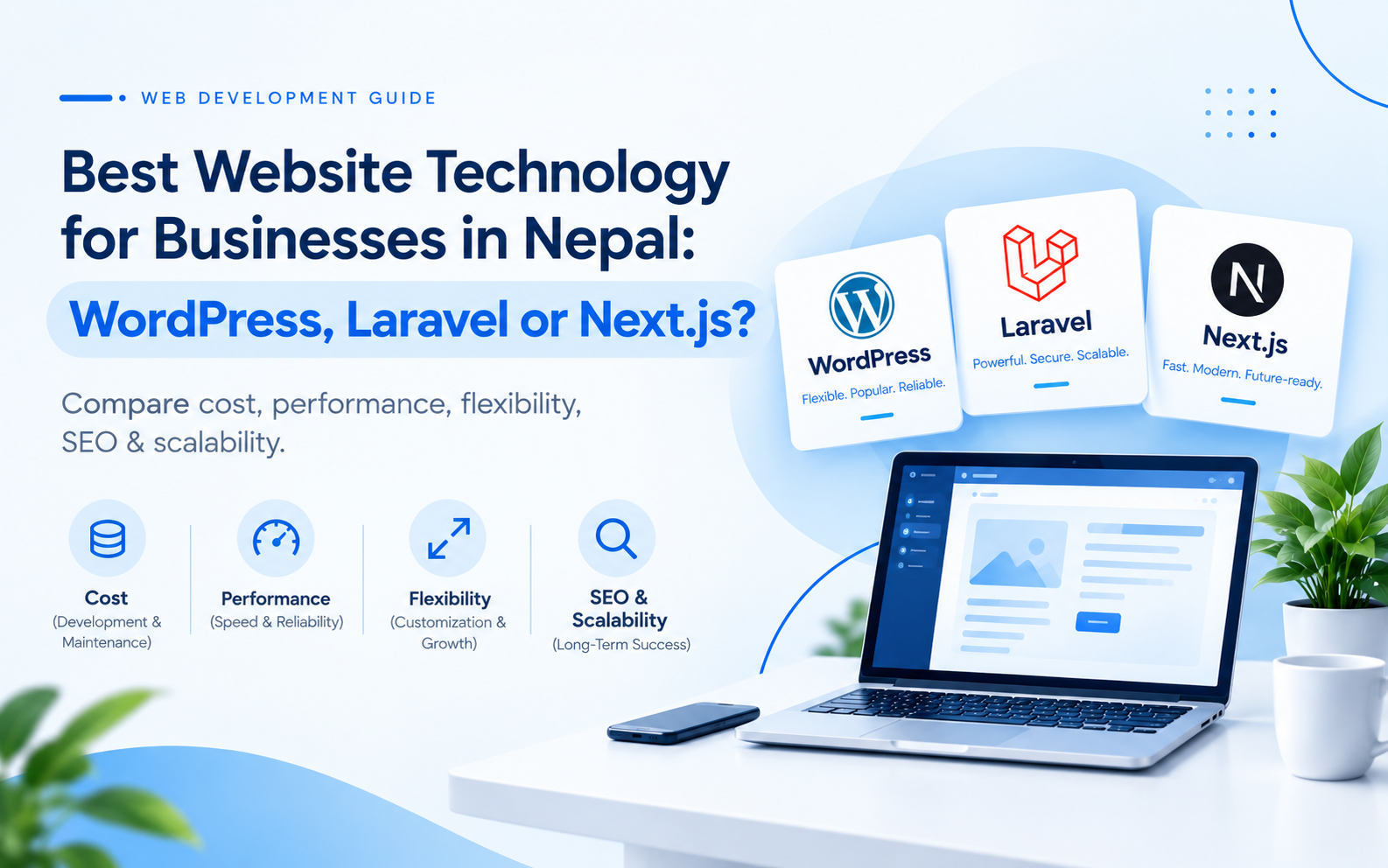
Best Website Technology for Businesses in Nepal: WordPress, Laravel or Next.js?

October 7, 2026
15 min read
Share:
best website technology for businesses in Nepal
Listen to this article

WordPress, Laravel or Next.js? Compare cost, SEO, GEO, speed and local payments to choose the best website technology for your business in Nepal.

Best Website Technology for Businesses in Nepal

If you run a business in Nepal and you're about to get a website built, someone has probably told you to "just use WordPress." Someone else swears by Laravel. A developer friend won't stop talking about Next.js. They can't all be right, but honestly, they can all be right, depending on what you're building. The best choice is the one that fits your budget, your team and where you want the business to be in three to five years.

Here's how we'd think about WordPress, Laravel and Next.js for a business in Nepal: real budgets in NPR, eSewa and Khalti, who you can actually hire, where to host, and how your customers browse (mostly on a phone, often on patchy data).

Quick Answer

  • WordPress if you want a good-looking business site, blog or small online shop up and running quickly without a big budget.
  • Laravel if you're building something with real logic behind it, like bookings, a portal, an ERP or a marketplace.
  • Next.js if speed, SEO and a polished feel matter most, or you're building a product rather than a brochure site.

WordPress: The Practical Default

WordPress runs a huge chunk of the web, and it's the default choice for most small and mid-sized businesses in Nepal. It's a content management system built on PHP, with thousands of themes and plugins, so most of what you need already exists.

What WordPress does well

  • You can launch in days or a few weeks, not months.
  • Your own staff can change text, photos, blog posts and products without calling a developer.
  • Developers are everywhere, from Kathmandu and Pokhara to freelancers across the country, which keeps prices sensible.
  • eSewa, Khalti, Fonepay and IME Pay all have plugins or integrations, usually through WooCommerce, and cash on delivery is easy to set up.
  • Yoast or Rank Math let even a beginner handle titles, meta descriptions and sitemaps.

Where it gets annoying

The usual problem is plugin pile-up. Every extra plugin slows the site a little and adds one more thing that can be hacked, and outdated plugins plus weak passwords are the most common way WordPress sites get broken into. The other limit is complicated logic. Once you start bending WordPress around a custom workflow, it gets messy and fragile fast.

Who it suits

Hotels and homestays, restaurants, schools and colleges, clinics, consultancies, trekking and travel agencies, NGOs, news sites, blogs and small online shops.

Related: Building a property portal? Read our guide to real estate website development in Nepal. For budgets and process, see web development in Nepal: cost, process and how to choose a company.

Laravel: The Custom Business Engine

Laravel is a PHP framework for building custom web applications from scratch. Instead of stitching together plugins, a developer writes code around how your business actually works.

What Laravel does well

Laravel is built for complexity: user roles, approval workflows, invoicing, reports, APIs. It comes with solid protection against common attacks like SQL injection and CSRF, and it scales from a small internal tool to a platform with a lot of users. Nepal has a healthy pool of Laravel developers and agencies, partly because PHP is so widely taught here. Hooking up local payment gateways, SMS providers, banks or government systems is usually straightforward with custom code.

The catch

  • It costs more and takes longer, because custom work needs planning, design and testing.
  • You'll rely on developers. Even small changes may need a programmer unless someone builds you a proper admin panel.
  • For a simple brochure site, it's overkill and you'd be wasting money.

Who it suits

Online shops with unusual requirements, booking and reservation systems, school or hospital software, cooperative and fintech tools, CRM and ERP systems, job portals and multi-vendor marketplaces.

Related: See how a large institutional website project comes together in our government website development case study for Nepal Oil Corporation. Need a mobile app alongside your platform? Check mobile app development cost in Nepal.

Next.js: The Modern, High-Performance Option

Next.js is a framework built on React. It makes very fast websites and web apps, and more startups and tech-focused agencies in Nepal are picking it up every year.

What Next.js does well

Speed is the big one. Pages can be pre-rendered and served quickly, which matters when your visitors are on mobile data outside the main cities. Because content is rendered on the server or generated ahead of time, search engines can read it properly. The experience feels smooth and app-like, which suits brands that want a modern image. Your team can use JavaScript or TypeScript across the whole stack, and Next.js happily sits in front of Laravel, WordPress (as a headless CMS) or any other API.

The catch

  • Experienced Next.js developers exist in Nepal, but there are fewer of them and they often charge more than WordPress developers.
  • Without a headless CMS, your non-technical staff can't easily update the site.
  • Deployment is different from traditional cPanel hosting. You'll usually use something like Vercel or a Node server.

Who it suits

Startups, SaaS products, digital agencies, high-traffic media sites, brands that want a premium feel, and projects aimed at both Nepali and international audiences.

Related: Comparing agencies for a modern build? Read top web development companies in Nepal for international clients.

Side-by-Side Comparison

FactorWordPressLaravelNext.js
Typical cost LowMedium to highMedium to high
Time to launch FastModerate to slowModerate
Ease of content editingExcellentDepends on admin panel builtNeeds a CMS
Custom featuresLimitedExcellentExcellent
SpeedGood (with optimisation)GoodExcellent
SEOVery goodGood (needs setup)Very good
Developer availability in NepalVery highHighModerate
Maintenance effortRegular updates neededDeveloper-ledDeveloper-led

Prices and timelines swing a lot between agencies, so get quotes from a few providers before you decide.

SEO and GEO: Which Technology Wins?

Any of the three can rank on Google and get cited by AI tools. How the site is built and written matters more than the framework. SEO is about ranking in Google and Bing. GEO (generative engine optimisation) is about making your content easy for tools like ChatGPT, Google AI Overviews, Perplexity and Claude to understand and quote.

Both come down to the same basics: fast pages, content that loads without JavaScript, a clear structure, and details people can trust.

FactorWordPressLaravelNext.js
Content visible to crawlersYes, server-rendered by defaultYes, with server-rendered viewsYes with SSR or static generation; avoid client-only rendering
Structured data (schema)Plugins such as Rank Math or YoastCustom JSON-LD in templatesCustom JSON-LD in components
Page speedNeeds caching and lean pluginsGood with cachingStrong by default
Editing titles, meta and sitemapsEasy, built into pluginsMust be built into the admin panelNeeds a CMS or code
Biggest SEO riskPlugin bloat, slow themesForgetting SEO fields in custom buildsClient-side rendering hiding content

SEO and GEO Checklist for Nepali Businesses

  • Put the direct answer in the first couple of sentences of every page. Snippets and AI answers love clear, quotable lines.
  • Write headings the way people actually ask questions, and add an FAQ.
  • Add schema markup (JSON-LD): Organization, LocalBusiness, Article, FAQPage and Product where they apply.
  • Keep your business name, address and phone number identical on your site, Google Business Profile, Facebook and local directories. It helps local SEO in Kathmandu, Pokhara and elsewhere.
  • If your audience needs both English and Nepali, publish both and use hreflang tags.
  • Don't block search or AI crawlers in robots.txt unless you mean to, and submit a sitemap in Google Search Console.
  • Show who wrote the page, when it was last updated and where your numbers come from.
  • Check Core Web Vitals, and test on mobile data, not just office Wi-Fi.
  • Get mentioned elsewhere: local directories, news sites, partners. Brands that show up across the web are more likely to be recommended.

Want the full plan? Our guide to SEO services in Nepal covers cost, process and what to expect.

Nepal-Specific Factors to Consider

ayment gateways. If you're selling online, check that eSewa, Khalti, Fonepay, IME Pay or card payments will work. All three options can handle them. WordPress has ready-made plugins; with Laravel and Next.js a developer usually builds the integration.

Phones and patchy data. Most Nepali users browse on mobile, and speeds vary a lot between Kathmandu Valley and the rest of the country. Keep pages light, compress your images and test on mobile data, whatever technology you choose.

Nepali language and Unicode. If you need Nepali content, test Unicode fonts, Preeti-to-Unicode conversion and Bikram Sambat dates early. Custom builds can support BS dates natively; WordPress needs a plugin or some custom work.

Hosting and domain. Hosting in Nepal can give lower latency for local visitors, while international hosting or a CDN is better for a global audience. Decide where your customers are first. A .com.np or .np domain builds local trust, and a .com works better for international reach.

Support after launch. The best technology is useless if nobody can maintain it. Pick a stack your agency or in-house team knows well, and agree on who handles updates, backups and security.

Selling online? Our guide to ecommerce development in Nepal covers platforms, payment gateways and costs. Comparing agencies? Read how to choose the best web design company in Nepal.

Which Should You Choose? A Simple Decision Guide

  • "I need a decent website, fast and cheap." → WordPress
  • "I want to sell online with eSewa or Khalti." → WordPress with WooCommerce, or Laravel if you need custom features
  • "I need logins, dashboards, approvals or reports." → Laravel
  • "I'm building a startup product, or I care a lot about performance and design." → Next.js
  • "I want a fast front end but easy content editing." → Next.js with a headless CMS, or Next.js in front of a Laravel or WordPress back end

Common Mistakes to Avoid

  • Picking what's trendy. A modern stack doesn't help if nobody on your team can maintain it.
  • Picking on price alone. The cheapest build often turns into the most expensive one after the rebuilds and fixes.
  • Forgetting maintenance. Budget every year for hosting, updates, backups and security.
  • Leaving SEO until the end. Plan structure, speed and content before design starts.
  • Not owning your stuff. Make sure you control your domain, hosting account and source code.

Frequently Asked Questions (FAQ)

Which is best for a small business in Nepal: WordPress, Laravel or Next.js?
For most small businesses, WordPress. It launches quickly, costs less and your team can edit content themselves. Go with Laravel for custom systems and Next.js when performance or a product-style experience is the priority.
Is WordPress good for SEO?
Yes. WordPress renders pages on the server and has plugins that handle titles, meta descriptions, schema and sitemaps. How well it ranks depends on decent hosting, a lean theme and not too many plugins.
When should I choose Laravel instead of WordPress?
When your site needs custom logic, like user roles, bookings, approvals, dashboards, reports or API integrations that plugins can't handle cleanly.
Is Next.js better for SEO than WordPress?
Not automatically. Next.js can be faster and gives developers more control, but a well-built WordPress site can rank just as well. If you go with Next.js, make sure it uses server-side rendering or static generation so crawlers can read your content.
Can I use eSewa, Khalti and Fonepay with all three?
Yes. WordPress has ready-made plugins; with Laravel and Next.js a developer usually builds the integration.
What is GEO and do I need it?
GEO is making your content easy for AI tools to understand and cite. If your customers ask ChatGPT or Google AI Overviews for recommendations, GEO helps your business show up in those answers. It's worth doing, and it mostly overlaps with good SEO.
How much does a website cost in Nepal?
It depends on scope, design and features. Our guide to web development in Nepal breaks down current ranges and what drives the price.

Discussion & Feedback

Share your thoughts, ask questions, or provide feedback on this blog. All comments are moderated before being published.

Leave a Reply

Your email address will not be published. Required fields are marked *

Recent Comments

Loading discussion...
Call: 9851029233Email: [email protected]