
Web Creation Nepal Private Limited
Get a Quote

Contact Support

977-01-5343968 / 9851029233[email protected]
Sunday – Friday: 09:00 AM – 06:00 PM

App Development in Nepal - Cost, Process & How to Choose the Right Partner

July 27, 2026
13 min read
Share:
App Development in Nepal
Listen to this article

Looking for an app development company in Nepal? Learn how to choose the right mobile app development partner, development process, cost, features, and technologies.

App development in Nepal

Today, almost every business is going digital. Whether you run an online store, travel company, school, hotel, restaurant, or service-based business, a mobile app can make it easier for your customers to connect with you.

But building a successful app is not just about writing code. You need a good idea, a simple and user-friendly design, the right technology, proper testing, and a reliable team to support the app after it goes live.

If you are looking for an App Development in Nepal, you may be wondering where to start and how to choose the right development partner.

In this guide, we will explain what you should look for when choosing a mobile app development company in Nepal, how the development process works, what features your app may need, and what factors affect the cost of developing a mobile app.

Why Nepal's App Market Is Growing Fast

You don't need to take our word for it — the numbers tell the story on their own:

MetricFigureWhat it means for you
Internet users in Nepal~16.6 million (56% of population)A large, reachable digital audience already exists
Mobile broadband share~89% of all broadband connectionsYour customers are overwhelmingly on phones, not desktops
Social media users~14.8 millionDistribution and app-store visibility both matter
IT graduates produced yearly~25,000+A deep, steadily growing local talent pool
Cost vs. Western markets40–60% lower for comparable workNepal is genuinely cost-competitive, not just "cheap"

Put simply: the demand (a mobile-first population) and the supply (a maturing developer ecosystem) are both here at the same time. That's a rare combination, and it's exactly why so many Nepali businesses — from trekking agencies to fintech startups — are moving from "should we build an app?" to "who should we hire to build it?"

App Development Cost in Nepal (2026 Pricing Table)

Let's be honest — "how much does an app cost" is a bit like asking "how much does a house cost." It depends entirely on what you're building. A five-screen brochure app and a payment platform with real-time tracking are both technically "apps," but they're worlds apart in effort.

Here's a realistic breakdown based on current rates among Nepali development companies. (If you're comparing this against website costs too, our Website Development Cost in Nepal guide breaks down web pricing the same way.)

App TypeCost (NPR)Cost (USD approx.)Example
Basic / informational app50,000 – 300,000$375 – $2,250Restaurant menu, portfolio, brochure app
Mid-complexity app300,000 – 1,200,000$2,250 – $9,000Restaurant menu, portfolio, brochure app
E-commerce / marketplace app800,000 – 2,500,000$6,000 – $19,000Product catalog, cart, payment gateway, order tracking
Complex / enterprise app2,500,000 – 5,000,000+$19,000 – $38,000+Product catalog, cart, payment gateway, order tracking

What Actually Affects the Price

A few honest factors that move the number up or down:

  • Platform choice. Building for both iOS and Android using a cross-platform framework like Flutter usually adds only 20–40% over building for one platform — compared to nearly double the cost for two fully separate native builds.
  • Design complexity. A custom, branded interface with smooth animations takes longer (and costs more) than a template-based layout.
  • Backend and integrations. Every payment gateway (eSewa, Khalti, IMEpay), map, SMS/OTP verification, or third-party API you add is more code to write and more things to test.
  • Data and security requirements. Apps that touch personal data, payments, or health records need extra security work — this isn't optional, it's what keeps you out of trouble later.

Planning an e-commerce app specifically? Our 6-step guide to starting an online shop in Nepal covers the storefront side in more depth.

  • Who's building it. Freelancers are the cheapest option, boutique agencies sit in the middle, and larger established agencies charge more — usually in exchange for more accountability and support when something breaks.

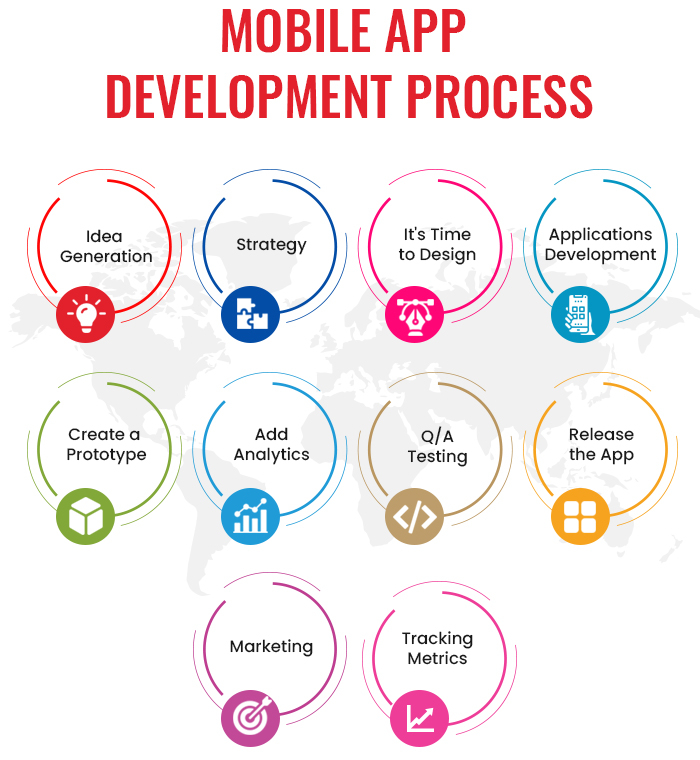
App Development Process, Step by Step

Here's what a trustworthy process actually looks like. If a company skips straight from "hi" to "we'll start coding," that's worth noticing.
StageWhat HappensTypical Duration
1. Discovery & RequirementsDefine goals, target users, core features, and success metrics1–2 weeks
2. UI/UX DesignWireframes → clickable prototype → final visual design2–4 weeks
3. DevelopmentFrontend + backend build, in sprints with regular check-ins4–12 weeks
4. QA & TestingFunctional testing, device testing, security and performance checks1–3 weeks (parallel with dev)
5. LaunchApp Store / Play Store submission, compliance checks1–2 weeks
6. Post-launch SupportBug fixes, monitoring, updates, feature additionsOngoing

Flow

Mobile App Development in Nepal


How to Choose the Right App Development Company in Nepal

Use this side-by-side checklist while you're comparing quotes. (The same evaluation logic applies if you're also vetting web design partners — see our guide on how to choose the right web design company in Nepal.)
What to CheckGood SignRed Flag
PortfolioLive apps you can actually download and testOnly screenshots or mockups
ProcessClear stages with milestones and sign-offs"We'll just start coding"
CommunicationRegular updates, a single point of contactDelayed replies, unclear ownership
ContractFixed scope, timeline, and payment milestones in writingVague verbal agreements
Post-launch supportDefined maintenance plan and pricingNo mention of what happens after launch
Technology fitRecommends tech based on your goalsPushes one framework regardless of use case
Reviews & referencesVerifiable clients you can actually contactNo references provided
IP ownershipSource code and design files transferred to you on completionUnclear who owns the final code

If a company checks most of the "good sign" boxes, you're in safe hands. If they hit even two or three red flags, it's worth pausing — those problems tend to compound after you've already paid.

Highlight: IP ownership is the checklist item most businesses forget to ask about — and the one that causes the most pain later if you ever want to switch developers.

Freelancer vs. Agency vs. In-house Team

OptionBest ForCostRisk Level
FreelancerVery small, simple apps with a tight budgetLowestHighest — limited accountability, single point of failure
AgencyMost businesses — balances cost, quality, and supportMid to highLower — team-based, contracts, ongoing support
In-house teamCompanies building a core product long-termHighest (salaries, tools, management)Lowest long-term, but slow to start

For most small and medium businesses in Nepal, an established agency hits the sweet spot: you get a real process, real accountability, and someone to call when something needs fixing — without the overhead of running your own tech team.

Common Mistakes Businesses Make When Hiring a Developer

  • Choosing the cheapest quote without asking why it's cheap. Sometimes it's genuinely good value. Often it means corners will be cut on testing, security, or support.
  • Not asking who owns the code. Some cheaper contracts quietly keep the source code with the developer. If you ever want to switch teams later, this can trap you.
  • Skipping the prototype stage. Approving a full build before seeing a clickable prototype means you won't catch design problems until it's expensive to fix them.
  • Forgetting about maintenance. An app isn't a one-time purchase — operating systems update, security needs patching, and users expect fixes. Budget for it from day one.
  • No written contract. A friendly conversation is not a contract. Get scope, timeline, payment terms, and ownership in writing, always.

Highlight: Businesses that skip a written contract are the ones most likely to end up in a dispute over scope — "I thought that was included" is the most common line we hear.

Still deciding between a website, a Facebook page, or an app for your business? Our comparison on website vs. Facebook page for businesses in Nepal can help you think through the bigger picture first.

Why Choose a Local Nepali Company Over an Overseas One

It's tempting to look abroad for "cheaper" offshore development, but local teams have real, practical advantages:

  • Same time zone, easier communication. No waiting a full day for a reply to a simple question.
  • Understanding of the local market. A Nepali team already knows how eSewa and Khalti integrations work, what local users expect, and how to navigate local app-store and business requirements.
  • Easier accountability. If something goes wrong, you can call, visit the office, or meet in person — not just send an email into a time-zone void.
  • Comparable quality, lower cost. Nepal's development costs run 40–60% below Western markets, without a meaningful drop in quality from established teams.

Highlight: For most small and medium Nepali businesses, "same time zone + local payment know-how" ends up saving more time and money than a slightly lower offshore quote.

Questions to Ask Before You Sign a Contract

  • Can you show me an app you've built that's live on the Play Store or App Store right now?
  • What exactly is included in the quoted price — design, backend, testing, launch, and support?
  • Who owns the source code and design files once the project is complete?
  • What happens if we need changes after the app is "finished"?
  • What's your maintenance plan, and what does it cost monthly or annually?
  • How will we communicate during the build — weekly calls, a shared board, daily updates?
  • What's the realistic timeline, and what could make it longer?
  • Frequently Asked Questions (FAQ)

    What is the average cost of app development in Nepal?
    Most business apps in Nepal cost between NPR 300,000 and NPR 10,00,000, depending on complexity, platform, and features. Simple apps can start as low as NPR 50,000; complex platforms can exceed NPR 2,000,000.
    How long does it take to build an app in Nepal?
    A simple app typically takes 4–8 weeks. A mid-complexity app with backend and integrations usually takes 2–4 months. Complex platforms can take 6 months or longer.
    Is it cheaper to hire a freelancer or an agency in Nepal?
    Freelancers usually quote lower prices, but agencies provide more accountability, structured processes, and post-launch support — which often reduces total cost over time.
    Should I choose a native app or a cross-platform app?
    For most businesses, cross-platform frameworks like Flutter offer the best balance of cost and reach, since one codebase runs on both iOS and Android. Native development makes sense mainly for apps needing deep, platform-specific performance, like heavy gaming or hardware integration.
    What should be included in an app development contract in Nepal?
    A solid contract should define the full scope of work, timeline with milestones, payment schedule, IP/code ownership on completion, and the post-launch support terms.
    Is Nepal a good place to outsource app development?
    Yes — Nepal offers costs 40–60% lower than Western markets, a growing pool of skilled developers (around 25,000 IT graduates yearly), and the advantage of same-time-zone communication for South Asian and international clients alike.

    Discussion & Feedback

    Share your thoughts, ask questions, or provide feedback on this blog. All comments are moderated before being published.

    Leave a Reply

    Your email address will not be published. Required fields are marked *

    Recent Comments

    Loading discussion...
    Call: 9851029233Email: [email protected]