
Web Creation Nepal Private Limited
Get a Quote

Contact Support

977-01-5343968 / 9851029233[email protected]
Sunday – Friday: 09:00 AM – 06:00 PM

School Management System Development in Nepal - Features, Cost & Process

October 29, 2026
12 min read
Share:
School Management System
Listen to this article

Planning a school management system in Nepal? See must-have features, costs in NPR, the development process and how to choose a developer.

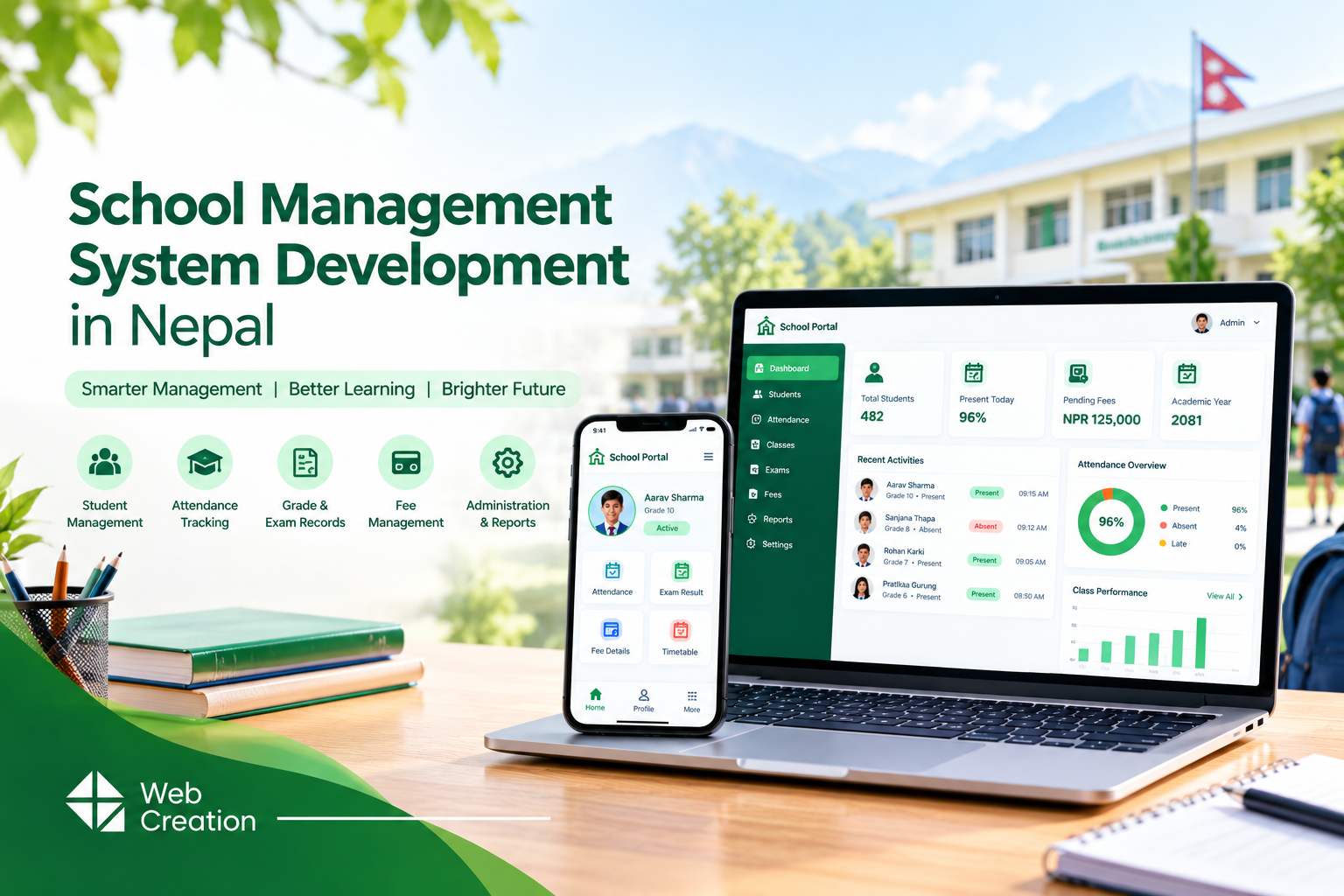
School Management System Development in Nepal

Running a school means handling admissions, attendance, exams, fees, timetables, teachers and parents all at once. When this work lives in registers, Excel sheets and phone calls, records get lost, mistakes creep in and staff spend hours on repeat tasks.

A school management system (SMS) brings all of this into one place. This guide explains what it includes, how it’s developed in Nepal, what it costs in NPR and how to choose the right developer. It’s written in simple language for principals, owners and administrators.

Looking for a public website instead? A school management system is internal software for running the school. If you need a website for admissions and notices, read our guide to School Website Development in Nepal.


What Is a School Management System?

A school management system is software that helps a school run its daily work digitally. It usually has separate logins for the admin, teachers, accountants, students and parents, and each person sees only what they need.It can be:

  • A web-based system used from a computer or phone browser
  • A mobile app for parents and teachers
  • A combination of both, which is the most common choice today

Why Nepali Schools Need One

Paper and spreadsheets work until the school grows. Common problems include:

  • Attendance and results take too long to record, and errors are hard to fix
  • Fee records don’t match, which causes disputes and late payments
  • Parents must visit the school just to ask about marks, dues or notices
  • Reports take days when management or the principal asks for them
  • Knowledge sits with individuals, so records can be lost when staff leave

A good system saves time, cuts errors and makes communication with parents clearer. It won’t fix everything on its own, but it gives your team more time for teaching and management.

Must-Have Features

These are the core features most schools need from day one.

1. Student information and admission

  • Student profiles with parent details, previous school and documents
  • Admission records
  • Class, section and roll number management

2. Attendance

  • Daily attendance for students and staff
  • Easy marking from a phone or computer
  • Reports and absence alerts to parents

3. Exams and results

  • Exam schedules and marks entry
  • Automatic grade and GPA calculation based on your school’s system
  • Report cards and mark sheets ready to print or share

4. Fee management

  • Fee structures by class, with discounts or scholarships
  • Receipts, due lists and reminders
  • Reports for the accounts team

5. Teacher and staff management

  • Profiles, attendance and class assignments
  • Leave records and basic payroll

6. Timetable and class routine

  • Class and teacher schedules
  • Fewer clashes and easier changes

7. Notices and communication

  • Notices, events and holiday announcements
  • Parent notifications by app, SMS or email

8. Role-based access

  • Admin, accountant, teacher, parent and student logins with limited permissions

Nice-to-Have Features

Add these once the basics are working well:

  • Online fee payment through eSewa, Khalti, Fonepay or bank transfer
  • Library management: book records, issue and return tracking
  • Transport management: routes, vehicles and student assignments
  • Hostel management for boarding schools
  • Online assignments and homework
  • Parent-teacher messaging
  • Inventory for school assets and supplies
  • Online class links connected to your video tool
  • Dashboards and analytics for management

A common mistake is asking for everything at once. Starting with the core modules and adding more later is cheaper, faster and easier for staff to learn.

Features Specific to Nepali Schools

Foreign software often misses local needs. When planning, check for:

  • Bikram Sambat (BS) and English dates, both supported
  • Nepali and English language options for parents and staff
  • Your grading system: letter grades, GPA, percentage or the format required by your level or board
  • Local payment methods: eSewa, Khalti, Fonepay and bank deposit slips
  • Printable formats matching your report cards, ID cards, certificates and fee receipts
  • SMS notices for parents who don’t use smartphones or apps
  • Performance on slow internet, which matters outside the cities

Ask for a live demo of these items, not just a feature list.

Ready-Made or Custom Development?


Ready-made softwareCustom development
CostLower upfront, usually monthly or yearly feesHigher upfront
SpeedQuick to startTakes longer to build
Fit to your schoolMay need workaroundsBuilt around your processes
FlexibilityLimited to the vendor’s featuresEasy to add or change features
OwnershipUsually subscription-basedDepends on agreement, so confirm in writing
Best forSmall or standard schoolsLarger schools, school groups or unique needs
Simple rule of thumb: If your school works in a fairly standard way, a ready-made or customizable product may be enough. If you have multiple branches, special workflows or want to own the system, custom development makes more sense.

School Management System Development Process

Here is how a typical project runs.

Step 1: Requirement gathering The developer meets the principal, teachers and accounts team to understand how the school really works: exam rules, fee structure, reports and approvals.

Step 2: Planning and scope You decide which features come first and which come later, and agree on the timeline and cost in writing.

Step 3: Design Screens and flows are designed to be simple for teachers and parents. Many staff have limited technical experience, so clarity matters more than looks.

Step 4: Development The system is built in stages. A good developer shows progress regularly so you can give feedback early.

Step 5: Data migration Existing student, fee and staff records are cleaned and moved into the new system. This step is often underestimated, so plan time for it.

Step 6: Testing The team tests attendance, results, fee calculations and permissions using real examples from your school.

Step 7: Training and launch Teachers, accountants and admin staff need practical training. Many schools run the old and new systems side by side for a short time before switching fully.

Step 8: Support and updates Schools change every year: new sessions, new fee structures, new rules. Ask about ongoing support, bug fixes and updates before you sign.

How Much Does It Cost in Nepal?

The cost depends on your school’s size and what you need. It also depends on whether you subscribe to ready-made software or build a custom system. Below are typical ranges.

Option 1: Ready-Made Software (Subscription)

TypeTypical cost (NPR)
Budget plans (basic modules)From about NPR 1,300 per month
Mid-range plansRoughly NPR 5,000 to 15,000 per month, depending on student count and modules
Premium products (online classes, accounting, larger schools)NPR 35,000+ per month

Some vendors charge per student, while others charge a flat monthly fee. Always check which model you’re being quoted, because per-student pricing gets expensive as your school grows.

Option 2: Custom Development (One-Time Build)

ScopeWhat’s usually includedEstimated cost (NPR)
BasicStudent records, attendance, fees, noticesNPR 80,000 - 2,00,000
StandardBasic + exams and results, teacher management, parent portal, SMSNPR 2,00,000 - 5,00,000
AdvancedStandard + mobile app, online payment, library, transport, analyticsNPR 5,00,000 - 12,00,000
Multi-branch / fully customMultiple campuses, custom workflows, integrationsNPR 10,00,000+ (quoted after requirements)

Estimates only. The final quote depends on your school’s requirements.

Yearly Running Costs

Itemcost (NPR)
Hosting and domainNPR 10,000 - 40,000 per year
SMS creditsDepends on the volume of messages
Maintenance and supportOften 10-20% of the build cost per year
Updates for new sessions or rule changesVaries, so ask for details

What Changes the Price

  • Number of students and users
  • Number of modules (basic records vs fees, transport, library, hostel and more)
  • Mobile app, on Android only or on both Android and iOS
  • Custom report cards and formats
  • Payment integration (eSewa, Khalti, Fonepay)
  • SMS integration and ongoing SMS costs
  • Multi-branch support
  • Data migration from old records
  • Training and support

Which Option Is Cheaper?

For a small or standard school, a ready-made subscription usually costs less to start. Over several years, though, subscription fees add up and you don’t own the system. Custom development costs more up front but gives you ownership and flexibility, which can be better value for larger schools or school groups.

Tip: Ask for an itemized quote that separates the build, hosting, SMS, support and yearly costs, so you can compare offers fairly.

For general pricing context, see our guides on Mobile App Development Cost in Nepal and Web Development in Nepal: Cost, Process & Best Company to Choose.

How to Choose a Development Company

Ask these questions before you decide:

  • Have you built school software before? Can you show a demo or reference?
  • Can it handle our grading and report card format?
  • Does it support BS dates and the Nepali language?
  • Who owns the source code and the data? Get this in writing.
  • What happens to our data if we stop working together?
  • How are backups and security handled?
  • What does support include, and for how long?
  • Is training included?
  • What is the timeline, and what happens if it’s delayed?
  • Are there extra costs for updates or new sessions?

Be careful of anyone who promises everything very cheaply and very quickly, or who can’t clearly explain support after launch. For more guidance on hiring, read Best Web Design Company in Nepal: How to Choose the Right One.

Common Mistakes to Avoid

  • Skipping staff involvement. If teachers and accountants aren’t consulted, they won’t use the system.
  • Asking for too many features at the start. Launch with essentials and grow.
  • Ignoring data cleanup. Messy old records make messy new data.
  • Not testing with real data. Try real exams and fee cases before the new session starts.
  • No training plan. Even the best software fails if staff don’t know how to use it.
  • Forgetting security. Student data is sensitive. Insist on role-based access, strong passwords and regular backups.
  • Launching in a busy period. Aim for a quieter time, such as before a new session.
  • Choosing only on price. Support quality matters more over the years.

Final Thoughts

A school management system works best when it fits how your school actually runs and your staff are involved from the start. Begin with the essentials, test them with real data, train your team properly and grow from there.

If you’re planning a school management system, or aren’t sure whether to buy ready-made or build custom, we can help you decide.

Planning a school management system?

Tell us your school size and what you need to manage. We’ll suggest the right features, timeline and approach, with no pressure and no jargon. 👉 Get a Free Consultation Call: 977-01-5343968 / 9851029233 (Sunday to Friday, 9 AM to 6 PM)

Frequently Asked Questions (FAQ)

What is a school management system?
It’s software that manages a school’s daily work, such as admissions, attendance, exams, fees, staff, timetables and communication with parents, all in one place.
How much does it cost to develop a school management system in Nepal?
Ready-made subscriptions can start from around NPR 1,300 per month, while premium products cost much more. Custom development typically starts from about NPR 80,000 for a basic system and can reach NPR 10,00,000 or more for advanced, multi-branch systems. Ask for an itemized quote and include hosting, SMS and support costs in your comparison.
How long does development take?
A basic system can take a few weeks to a couple of months. Larger systems with mobile apps, online payment and multiple branches take longer. Data migration and staff training also add time.
Can parents check results and fees on their phones?
Yes. A mobile app or a mobile-friendly web portal can show attendance, results, fee dues and notices.
Can it accept eSewa and Khalti payments?
Yes, payment gateways can be integrated. Confirm the setup requirements and transaction charges with your developer and the payment provider.
Does it work with the Nepali (BS) calendar?
It should. Make this a requirement and check it during the demo.
Will it work if the internet is slow or goes down?
Web-based systems need internet. Ask the developer how the system handles poor connectivity and what your offline backup process is.
Is student data safe?
It can be, if the system has role-based access, secure hosting, regular backups and clear data ownership terms. Ask about all of these before you sign
Can the system grow as our school grows?
A well-planned system can add modules, classes, users and branches later. Ask about scalability up front.
Should we choose ready-made or custom?
Ready-made works for standard needs and smaller budgets. Custom is better for unique workflows, multiple branches or long-term ownership.
Can you migrate our existing records?
Usually yes, from Excel sheets or other software. The cleaner your records, the smoother the migration.
What’s the difference between a school website and a school management system?
A website is public and shows information to parents and applicants. A management system is internal software used to run the school. Many schools need both. See School Website Development in Nepal.

Discussion & Feedback

Share your thoughts, ask questions, or provide feedback on this blog. All comments are moderated before being published.

Leave a Reply

Your email address will not be published. Required fields are marked *

Recent Comments

Loading discussion...
Call: 9851029233Email: [email protected]