
Web Creation Nepal Private Limited
Get a Quote

Contact Support

977-01-5343968 / 9851029233[email protected]
Sunday – Friday: 09:00 AM – 06:00 PM

On-Demand Service Marketplace Development in Nepal

October 13, 2026
15 min read
Share:
On-Demand Service Marketplace Development in Nepal
Listen to this article

Build an on-demand service marketplace in Nepal with multi-vendor booking, built-in CRM, and eSewa/Khalti payments. Features, process, and cost explained.

On demand Service Marketplace

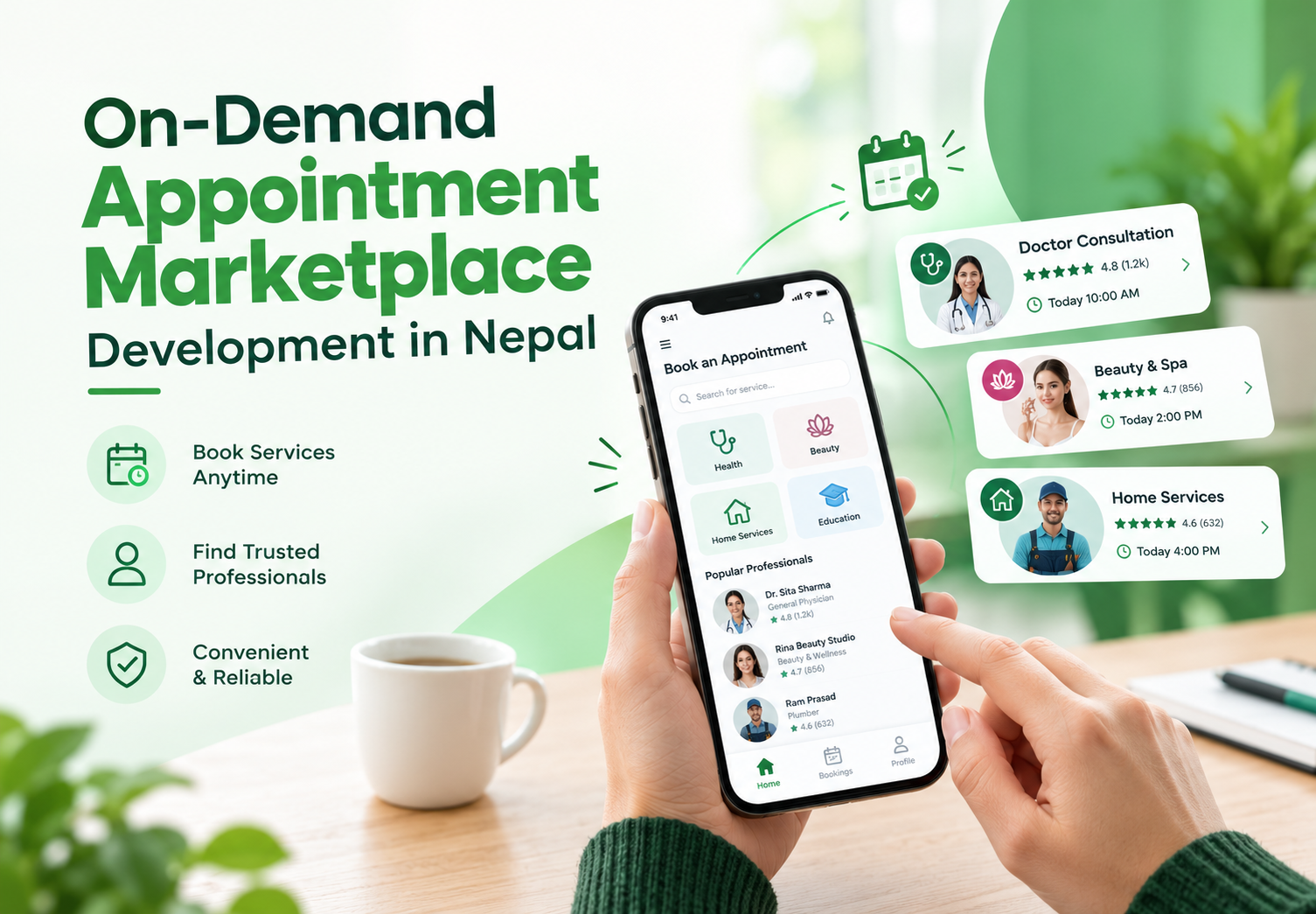
An on-demand service marketplace is a website and mobile app where customers find local service providers, such as salons, clinics, tutors, cleaners, and electricians, and book them instantly. Providers manage appointments and clients through a built-in CRM, and the platform owner earns through commissions, subscriptions, or featured listings. In Nepal, a marketplace like this is usually built with local payments (eSewa, Khalti, IME Pay), SMS reminders, and a mobile-first design, and it works best when launched as an MVP in one city and one category first.

Planning a marketplace? Get a free consultation from Web Creation Nepal and receive a feature plan for your idea.

Think about how people find a plumber, salon, tutor, or clinic today. They search online, call several numbers, wait for replies, and often give up. Service providers face the opposite problem: empty time slots, missed calls, and no-shows.

An on-demand service marketplace solves both problems. Customers search, compare, and book in minutes. Providers get steady bookings and a simple system to manage them. As the platform owner, you build a scalable business with recurring income.

This guide explains what a service marketplace is, how it works, which features you need, how it earns money, and how to build one in Nepal. If you want the CRM basics first, read our post on the Appointment CRM SaaS model.

What Is an On-Demand Service Marketplace?

An on-demand service marketplace is an online platform where multiple independent service providers list their services and customers book them directly, often in real time. Think of it as a “service mall” where every shop is a separate provider and you own the mall.

It usually has three connected parts:

  • Customer app or website: search, book, pay, review
  • Provider dashboard: calendar, services, staff, customers, earnings
  • Admin panel: approvals, commissions, payments, reports

Simple example: A customer in Lalitpur opens your app, selects “AC Repair,” compares nearby technicians by price and rating, books a 4 PM slot, pays through Khalti, and receives a confirmation. The technician sees the job instantly, and the system sends an automatic reminder.

How Does an On-Demand Service Marketplace Work?

  • Provider joins. A business or professional registers, submits details, and is approved by the admin.
  • Provider sets up a profile. They add services, prices, photos, staff, and working hours or service areas.
  • Customer searches. They filter by location, category, price, rating, and availability.
  • Customer books. They choose a service, provider, date, and time.
  • Payment happens. Online payment, a deposit, or cash after service, depending on your setup.
  • Reminders are sent. SMS, email, or push notifications reduce no-shows.
  • Service is completed. The customer leaves a review, and the platform records the job.
  • Platform earns. Commission or subscription revenue is calculated automatically.

Urban Company-Style Platform, Built for Nepal

Many founders describe their idea as “an app like Urban Company.” That means a single app where customers book trusted professionals for home and personal services at a clear price, with a verified provider, a scheduled time, and online payment.

A global app cannot easily match what a local platform can offer. A Nepal-focused marketplace can include:

  • Local payments: eSewa, Khalti, IME Pay, bank transfer, and cash on service
  • Nepali and English language support
  • Local provider verification: citizenship or business registration checks, depending on your policy
  • City and ward-level service areas across Kathmandu Valley and other cities
  • Local customer support by phone, chat, or WhatsApp
  • Pricing that fits the Nepali market

You do not have to copy any existing app. The strongest local platforms focus on the services their city needs most and do them well.

Types of Service Marketplaces

Home services. Cleaning, plumbing, electrical work, AC repair, pest control, painting, and appliance repair. These bookings are frequent, and commission works well here.

Beauty and wellness. Salons, spas, barbers, makeup artists, and massage. Customers book repeatedly, so subscription plans and loyalty features perform well.

Healthcare. Clinics, dentists, physiotherapy, and diagnostic labs. Appointment slots, reminders, and patient history are the key features.

Education and training. Home tutors, music classes, language courses, and exam preparation. Trial classes, packages, and reviews build trust.

Fitness. Gyms, yoga instructors, and personal trainers. Class schedules and recurring memberships are important.

Automotive. Vehicle servicing, car wash, detailing, and roadside help. Pickup, drop-off, and live status updates add value.

Professional services. Legal, tax, accounting, and consulting. Online consultations and document sharing help here.

You can launch with one type and add others once your provider base grows.

Appointment Booking and CRM: The Engine Behind the Marketplace

Many platforms stop at taking bookings. A marketplace with a strong appointment and CRM (Customer Relationship Management) system goes further, which is what makes providers stay and pay.

A built-in CRM helps providers:

  • Store customer profiles with contact details, preferences, and notes
  • Track visit history and see who is a regular and who has not returned
  • Send automatic reminders and follow-up messages
  • Reduce no-shows through confirmations and easy rescheduling
  • Run promotions to bring back inactive customers
  • Collect feedback and improve their service

For you as the owner, a useful CRM means providers rely on your platform daily, which makes subscription revenue far more stable.

Key Features of a Service Marketplace

Features for Customers

  • Sign-up with phone number, email, or social login
  • Search and filters by location, price, rating, and availability
  • Real-time slot booking
  • Online payment or pay-after-service
  • Booking history, rescheduling, and cancellation
  • Ratings and reviews
  • SMS, email, and push notifications
  • Favourite providers and repeat booking
  • Nepali and English interface

Features for Service Providers

  • Business profile with services, prices, photos, and hours
  • Calendar and appointment management
  • Staff, branch, and service-area management
  • Built-in CRM with customer records
  • Booking requests: accept, reject, reschedule
  • No-show tracking and deposit rules
  • Earnings reports and payout tracking
  • Coupons, packages, and promotions

Features for the Admin (Platform Owner)

  • Provider registration, verification, and approval
  • Commission and subscription plan settings
  • Category and service management
  • Payment, refund, and payout control
  • Dispute and review moderation
  • Analytics: bookings, revenue, top providers, repeat customers
  • Banner, content, and notification management

Advanced Features to Add Later

  • Live chat and video consultation
  • Loyalty points and referral rewards
  • Google Maps integration and “near me” search
  • Live job tracking
  • AI-based recommendations and smart scheduling

How the Marketplace Makes Money

Revenue modelHow it worksBest for
CommissionYou keep a percentage of each bookingHome services, high-volume jobs
Subscription (SaaS)Providers pay monthly or yearly for the CRM and listingSalons, clinics, tutors
Featured listingsProviders pay to appear at the top of resultsCompetitive categories
AdvertisingBrands pay to promote on your platformOnce you have steady traffic
Booking feesCustomers pay a small convenience feeUrgent, on-demand services

Many platforms combine commission plus subscription: a low monthly plan gets providers started, and commission grows as bookings grow.

Why Build One in Nepal Now?

  • Growing smartphone and internet use, especially in cities such as Kathmandu, Lalitpur, Bhaktapur, Pokhara, Chitwan, and Biratnagar.
  • Digital payments are mainstream. eSewa, Khalti, IME Pay, and mobile banking make online booking payments practical.
  • Most service businesses are still unorganised. Bookings often happen by phone calls, walk-ins, or Facebook and Instagram messages.
  • Customers want convenience. People increasingly expect to compare, book, and pay from their phones.
  • Competition is limited in many categories, so early movers can build a trusted local brand.

Marketplace vs Standalone Booking Software

Frequently Asked Questions (FAQ)

What is an on-demand service marketplace?
It is an online platform where customers find and book services from multiple providers, and providers manage bookings and clients through a built-in CRM. The platform owner earns through commissions, subscriptions, or other fees.
How is a service marketplace different from a booking website?
A booking website serves one business. A marketplace serves many providers at once, brings customers to them, and earns revenue from the whole network.
How much does it cost to build an app like Urban Company in Nepal?
The cost depends on platforms, features, integrations, and design. A focused MVP costs much less than a full multi-city platform. Contact us for a quote based on your exact needs.
How do service marketplaces make money?
Common models are commission per booking, provider subscriptions, featured listings, advertising, and customer booking fees. Many platforms combine commission and subscription.
Which technology is best for a multi-vendor marketplace?
The right stack depends on your scale and team. Popular choices include Laravel or Node.js for the backend, React or Next.js for the web, and Flutter or React Native for mobile apps. We recommend a stack after reviewing your requirements.
Which services can I include?
Home services, beauty, healthcare, tutoring, fitness, automotive, and professional services are common. Most founders start with one category.
Can I accept eSewa and Khalti payments?
Yes. Local gateways such as eSewa, Khalti, and IME Pay can be integrated, along with cards and pay-after-service options. Gateway approval depends on each provider’s requirements.
How does the platform reduce no-shows?
Through automatic confirmations, SMS and push reminders, easy rescheduling, and optional booking deposits.
How long does development take?
It depends on scope. A basic MVP usually takes a few weeks to a few months, while a full platform with mobile apps takes longer. We give a timeline after reviewing your requirements.
Do I need a mobile app, or is a website enough?
You can start with a mobile-friendly website and add apps later. Apps are recommended for repeat bookings and push notifications as you grow.
Will I own the source code and data?
Ownership terms are agreed in the project contract. At Web Creation Nepal, we discuss this clearly before development begins.
Do you provide support after launch?
Yes. We offer maintenance, updates, bug fixes, and new feature development.

Discussion & Feedback

Share your thoughts, ask questions, or provide feedback on this blog. All comments are moderated before being published.

Leave a Reply

Your email address will not be published. Required fields are marked *

Recent Comments

Loading discussion...
Call: 9851029233Email: [email protected]